
Quick Summary
When an automatic driveway gate stops or reverses unexpectedly, troubleshooting gate photo eyes in Anaheim involves identifying beam obstructions, dirty optical lenses, or bracket misalignments. While routine lens cleaning and manual alignment can be handled safely with simple tools, Ironworks Gate Co. advises hiring a certified technician for internal wiring faults, control-board issues, or safety sensor replacements. After reading this guide, property owners will know how to diagnose common sensor errors and decide when to perform quick DIY maintenance or schedule same-day professional repairs.
Troubleshooting Gate Photo Eyes in Anaheim: Fast Repair Guide
When your driveway gate stops midway, immediately reverses, or refuses to close, safety photo eyes may be involved. Photo eyes are designed to prevent closing when the beam is interrupted or the sensors are not communicating correctly with the operator.
Common possible causes include obstruction, misalignment, contamination, wiring faults, power loss, or sensor failure. With guidance from Ironworks Gate Co., this guide walks through diagnosing, cleaning, realigning, and testing gate photo eyes.
[4]
Quick Diagnostic Checklist
Before beginning, review these preliminary checks:
- Check the status LEDs: Consult the applicable model manual, as indicator light patterns vary by manufacturer. Changes in indicator lights typically point to misalignment, an active obstruction, or power loss.
- Check the path: Inspect the area between the posts for physical objects, debris, spiderwebs, or obstacles blocking the line of sight.
- Inspect the lenses: Check lenses for dust, dirt, or physical damage that may diffuse or block the infrared beam.
Anaheim planning documents state that vehicle gates must comply with the current City of Anaheim Engineering Standard Detail 475 and are subject to City Engineer approval. While basic surface cleaning and checking alignment are standard maintenance steps, electrical testing, enclosure access, wiring repairs, trenching, control-board work, and safety-system repairs should be performed by a qualified technician using the operator manual.[1]
Tools and Safety Measures
To safely inspect and adjust photo eyes, gather the following basic tools:
- Soft, clean dry or slightly damp cloth
- Phillips and flathead screwdrivers
- Small torpedo level or string line
Safety reminder: Always switch off main electrical power to the gate operator before performing maintenance. Electrical testing, enclosure access, wiring repairs, and control-board work should be performed by a qualified technician using the operator manual.
Step 1: Check Power and Status Indicator LEDs
Refer to the applicable model manual to interpret status lights on the transmitter and receiver units, as indicator patterns vary across different models.
In standard configurations, the transmitter projects a beam across the driveway to the receiver. When aligned and powered, the diagnostic LEDs reflect normal status. If indicators show a fault or do not illuminate:[3]
- Check the main breaker panel to confirm the circuit has not tripped.
- Have a qualified technician access the enclosure to inspect fuses, verify incoming power, and perform any necessary electrical testing.
- If power is present at the board but the sensors do not power on, have a qualified technician inspect the low-voltage wiring.
Step 2: Clean Lenses and Clear the Beam Path
Contamination on lenses or physical obstructions in the optical path can interfere with sensor operation.
- Clean the lenses: Gently wipe the sensor lenses with a soft, dry or slightly damp cloth. Avoid harsh chemicals, solvents, or abrasive pads.
- Clear insect debris: Brush away cobwebs and clear any nests or debris from around the sensor housings.
- Trim nearby landscaping: Trim back overgrown vegetation, branches, or tall grass near the driveway that may blow into the optical path.
Step 3: Realign the Transmitter and Receiver
Vibration, physical contact, or ground movement are possible factors that can cause mounting brackets to shift out of alignment.
A mounting height of 6 inches above the surface is a criterion documented in Hawaii procurement specifications, rather than a universal residential standard. Installers and owners should follow the operator manufacturer’s instructions and applicable local requirements.
- Loosen the bracket hardware: Loosen the mounting screws slightly to allow manual adjustment of the housing.
- Adjust alignment: Slowly adjust the horizontal angle and vertical pitch until the status indicators signal proper alignment according to the manufacturer’s manual.
- Secure the hardware: Tighten the mounting screws firmly. Test the alignment by interrupting the beam to confirm the indicator responds.
For wide gate openings where visual alignment is difficult, a string line or level can assist in establishing the line of sight.
Step 4: Inspect Low-Voltage Field Wiring
Need troubleshooting gate photo eyes anaheim?
We’re available now - call for a fast, free estimate.
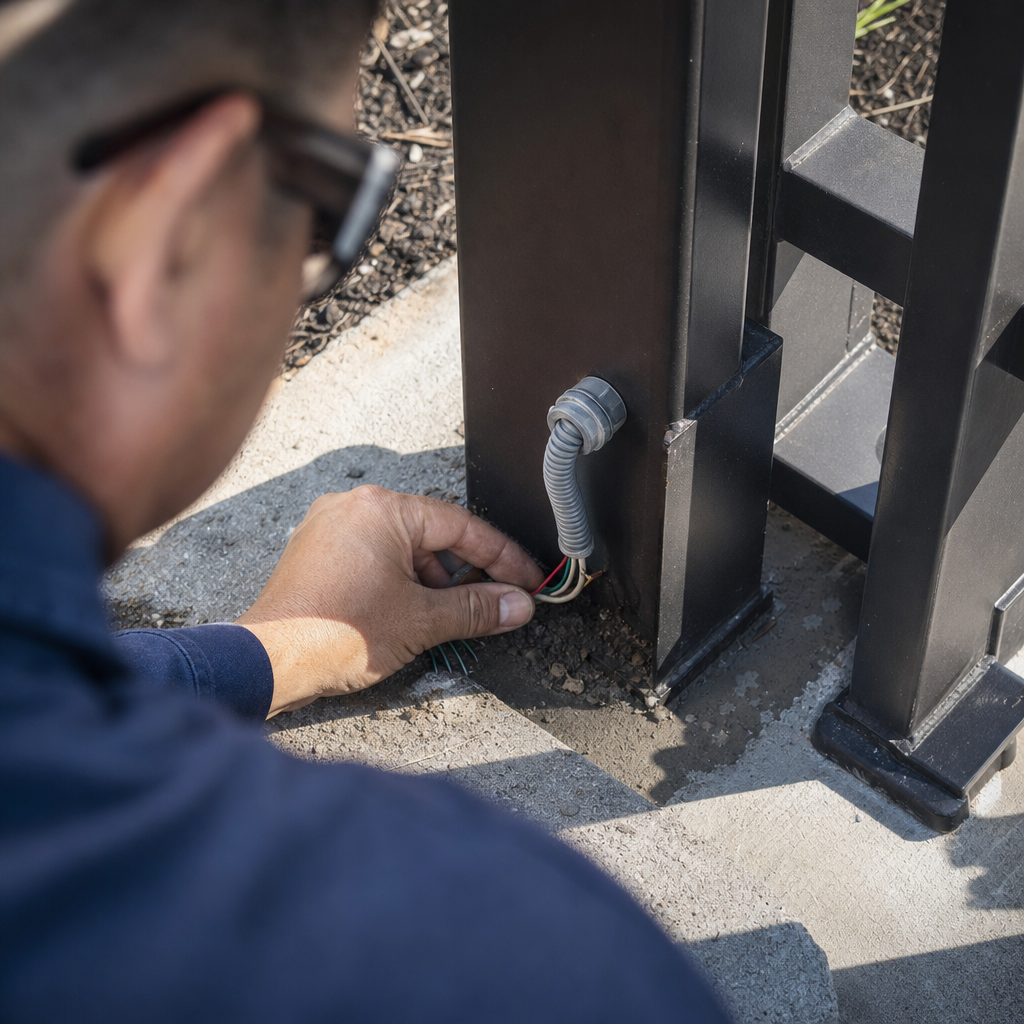
Unverified possibilities such as soil movement, water intrusion, or physical damage can lead to damaged wiring or loose connections.
All wiring inspections involving control enclosures, continuity testing, underground conduit, or wiring repairs should be performed by a qualified technician using the operator manual.
Step 5: Potential Optical Interference
According to Ironworks Gate Co., low-angle sunlight or glare represents a possible model- and site-specific cause of optical interference. If ambient light conditions disrupt sensor communication, consult the manufacturer’s guidance for approved solutions, such as visors, hoods, or configuration options supported by the specific model.
Step 6: Control Board Safety Inputs
Monitored photoelectric sensors must remain connected and operational when used as entrapment-protection devices. Never bypass or disconnect safety sensors.
If sensors are clean and aligned but the gate operator still registers a safety fault, internal component failure or control-board input issues may be present. Electrical testing, enclosure access, control-board work, and safety-system repairs should be performed by a qualified technician using the operator manual.
Industry Specifications and Case Studies
Public procurement records and project documentation provide examples of gate safety sensor maintenance and operational standards:
- In a documented repair at the El Monte courthouse, technicians replaced one photo eye and one sensing edge following age-related failure.
- Arlington maintenance specifications require regular inspection of gate controls, power, and wiring, along with the replacement of photo eyes or safety sensors when defective.
- Hawaii procurement specifications require that photo eye beam interruption immediately stops downward gate travel and causes the gate to reverse to the fully open position.
When to Call a Professional Gate Technician
Electrical testing, enclosure access, wiring repairs, trenching, control-board work, and safety-system repairs should be performed by a qualified technician using the operator manual. Call a professional for:
- Trenching, conduit work, or pulling new underground low-voltage wiring
- Control-board diagnostic troubleshooting and circuit repairs
- Replacing failed safety sensors or entrapment-protection devices
- Structural hinge or post repairs that affect sensor positioning
The City of Anaheim states that most improvements require permits before construction, while cosmetic work generally does not. Property owners should verify specific permit requirements directly with the Building Division.[2]
Frequently Asked Questions
Why does my automatic gate start to close and then immediately reopen?
As explained by Ironworks Gate Co., a mid-travel reversal occurs when the safety circuit detects an interruption or loses communication with a sensor. Common possible causes include obstruction, misalignment, contamination, wiring faults, power loss, or sensor failure.
How high off the ground should gate photo eyes be mounted?
Placement criteria vary depending on equipment and jurisdiction. For instance, a 6-inch mounting height is documented in Hawaii procurement specifications. Always follow the operator manufacturer’s instructions and applicable local requirements.
Can I clean gate sensor lenses with household glass cleaner?
Clean lenses gently with a soft, dry or slightly damp cloth. Avoid harsh chemical cleaners, solvents, or abrasive materials.
Can I bypass the safety sensors if my gate is stuck open?
No. Monitored photoelectric sensors must remain connected and operational when used as entrapment-protection devices. Never bypass or disconnect safety sensors. If your system malfunctions, contact a qualified technician using the operator manual to complete repairs.[5]
Need troubleshooting gate photo eyes anaheim?
We’re available now - call for a fast, free estimate.
Sources
- City of Arlington Automatic Gates Scope of Work Document … – arlingtontx.gov
- Building Permits in Anaheim – PropertyZoned – propertyzoned.com (2026)
- nimbio.com · gate-photo-eyeGate Photo Eye Guide: Fix, Align & Replace for 2026 – nimbio.com (2026)
- [PDF] attachment no. 1 – Anaheim.net – anaheim.net (2025)
- PC 2022/02/28 – IIS Windows Server – Anaheim.net – records.anaheim.net (2022)
Frequently Asked Questions
How can I stop direct sunlight from triggering false sensor stops on my Anaheim driveway gate?
Low-angle sunlight can blind infrared receivers, causing the operator to detect a phantom obstruction during specific times of day. You can resolve optical interference by fitting manufacturer-approved sun hoods, visors, or swapping the physical positions of the transmitter and receiver across the driveway. If sunlight issues persist, Ironworks Gate Co. can install specialized polarized photo eyes designed for high-glare environments.
How do I determine if a photo eye has completely failed or just has a wiring issue?
If diagnostic LEDs fail to illuminate after confirming your main breaker is on, the system is suffering from a severed low-voltage line, blown fuse, or internal sensor failure. Because diagnosing low-voltage continuity and control-board inputs involves opening the operator enclosure, an electrical test by a professional is recommended. Ironworks Gate Co. can inspect your field wiring and control board to isolate the exact electrical fault safely.
Do I need a municipal permit to replace broken gate photo eyes in Anaheim?
Routine maintenance and like-for-like safety sensor replacements generally do not require a building permit under City of Anaheim guidelines. However, running new underground conduit or completing major electrical modifications must comply with City of Anaheim Engineering Standard Detail 475 and may require formal review. Ironworks Gate Co. ensures all safety device installations and same-day sensor repairs meet local engineering standards.
About the author
 |
David Harrison David Harrison is a seasoned technical writer with over eight years of experience specializing in the access control and home security industries. Holding a Bachelor’s degree in Communications from California State University, Fullerton, he translates complex gate repair diagnostics and pricing structures into clear, actionable advice for property owners. David’s practical insights help Orange County residents and businesses navigate automatic gate maintenance with confidence and transparency. |
Gate not opening, off track, or opener dead?
We’re available now - call for a fast, free estimate.
Call Now - Free Estimate