
Quick Summary
Driveway gate access lockouts are frequently caused by isolated low-voltage wiring faults, environmental debris, or misaligned safety sensors rather than complete system breakdowns. Ironworks Gate Co. serves Anaheim properties by isolating specific component failures across keypads, telephone entry panels, and loop detectors to deliver targeted repairs without unnecessary full replacements. After reviewing these diagnostic steps, property owners will understand how entry systems are serviced and can schedule a free assessment or same-day gate access control repair in Anaheim.
Gate Access Control Repair – Diagnostic & Repair Overview
When an automated driveway gate stops responding to a keypad, intercom, or remote, daily access is interrupted. While the broader access control market continues to expand, authoritative repair data specific to local areas remains limited. Most access control problems are not catastrophic system failures requiring a complete overhaul. In many cases, the issue is an isolated low-voltage wiring break, power interruption, a failing relay, or grit blown into the housing during high-wind events. Technicians, such as those at Ironworks Gate Co., typically isolate the failure point and resolve it on-site.[1]
Whether managing a classic wrought iron gate on a flat residential property or an automated slide gate on a sloped hillside driveway, resolving these issues requires proper diagnostic tools and replacement parts tailored to the specific system type.
What You Need for Gate Access Control Repair
Diagnosing automated driveway gate entry systems requires isolating basic electrical and mechanical faults from general environmental wear. Gate access control systems frequently experience wear from high summer temperatures, windblown dust, and ground movement on sloping terrain. Accurate field testing helps prevent unnecessary component replacements when only a single sensor or connection is faulty.[2]
Essential Diagnostic Tools and Safety Gear
Pinpointing low-voltage faults safely requires dedicated testing tools:
- Digital Multimeter: Measures true AC and DC voltage drops under load across 12V and 24V step-down transformers.
- Manufacturer Cabinet Keys and Tamper Bits: Unlocks diagnostic access ports for major brands without damaging weather seals.
- Insulated Wire Probes and Test Leads: Safely tests dry contact relay triggers, Wiegand data lines, and safety loops.
- Electronic Contact Cleaner and Optical Wipes: Cleans fine sand, carbon build-up, and insect debris from sensitive board contacts and photo lenses.
Access Control Overview
Automated gate hardware is subject to varied environmental stresses. For example, older conduit lines beneath concrete driveways can suffer from age and moisture intrusion, while thermal expansion and soil movement on slopes can cause intermittent wire breaks. Understanding these general factors allows technicians to locate the root cause of access lockouts rather than replacing circuit boards unnecessarily.
Step 1: Check Power Supplies, Breakers, and Low-Voltage Transformers
To diagnose an unresponsive access panel, start at the main power source before touching electronic boards. Lockouts frequently trace back to a tripped GFCI outlet near the gate operator, an overloaded breaker, a blown inline fuse, or a depleted battery backup system rather than a burned-out master logic controller.[3]
Testing Primary AC Breakers and Dedicated Outlets
Inspect the primary 120V line feeding the gate operator cabinet. In properties with long electrical runs between the subpanel and the driveway apron, ground faults and voltage drops can occur. Confirm that external reset buttons on outdoor weatherproof receptacles have not tripped during rainstorms or garden irrigation cycles.
Measuring Step-Down Transformer DC and AC Output
Keypads, telephone entry systems, and standalone receivers rely on dedicated step-down transformers converting 120V power into 12V or 24V AC or DC power. Using a multimeter across the secondary terminals, verify that the voltage matches the manufacturer rating under load, as recommended by Ironworks Gate Co. If the voltage drops significantly when an input command is triggered, the transformer or battery backup may be failing to supply enough current to energize the gate release relay.
Step 2: Inspect Keypads, Card Readers, and Telephone Entry Panels
Need gate access control repair anaheim?
We’re available now - call for a fast, free estimate.
Once steady incoming power is confirmed, focus on the peripheral input hardware at the driveway pedestal. Outdoor keypads and card readers are directly exposed to the elements, making them vulnerable to mechanical wear and electrical corrosion.
Cleaning Dust and Debris from Contact Pads
Fine dust driven by high winds can slip past worn rubber gaskets, settling between silicone button pads and copper printed circuit traces. This grit can prevent the contact from completing the circuit when a PIN is entered. Disassembling the front faceplate and clearing the contacts with quick-drying electronic solvent often restores operation without requiring new hardware.
Diagnosing Wiegand Wiring and Relay Trigger Faults
For standalone card readers, prox sensors, and telephone entry panels, signal transmission can be checked through standard testing steps:
- Check the Data 0 (green) and Data 1 (white) Wiegand lines for steady 5V DC resting voltage against the ground reference.
- Set the multimeter to audible continuity across the Normally Open (NO) and Common (COM) dry-contact output terminals.
- Enter an authorized access code or badge swipe and listen for the physical relay click while checking for continuity. If the relay clicks but the gate fails to move, the fault often lies in the command wire running between the pedestal and the operator board.
Step 3: Test Intercom Audio, Video Feeds, and Smart Cellular Relays
Intercom and video entry diagnostics require checking signal continuity and data stability between the gate pedestal and the indoor monitor or mobile network. Static on the line, pixelated video feeds, and dropped calls usually point to moisture in underground wire splices or local radio frequency interference.
Troubleshooting Hardwired Audio-Video Static and Signal Loss
On properties using legacy copper or CAT5/CAT6 cables run in underground conduits, moisture buildup is a frequent cause of signal degradation. Water in the conduit can cause capacitive coupling, producing an audible hum over voice lines and video distortion.
- Check wire continuity and shield grounding with an ohmmeter to verify the drain wire is tied to earth ground at only one end.
- Inspect screw terminals at the intercom station for copper oxidation and re-terminate frayed conductors.
- Use a test jumper cable to bypass suspect underground lines and isolate whether the cable or the unit itself is defective.
Resolving Smart Cellular and Wi-Fi Transceiver Disconnects
Modern access systems increasingly use cellular or Wi-Fi bridges to route calls directly to smartphones. If the gate fails to connect to the network, inspect the external antenna placement. Stucco walls, dense landscaping, and metal gate posts can weaken signal strength. Relocating the transceiver antenna to a higher position on the post or installing a dedicated cellular bridge can resolve intermittent wireless dropouts.
Step 4: Troubleshoot Photo-Eye Safety Sensors and Underground Loop Detectors
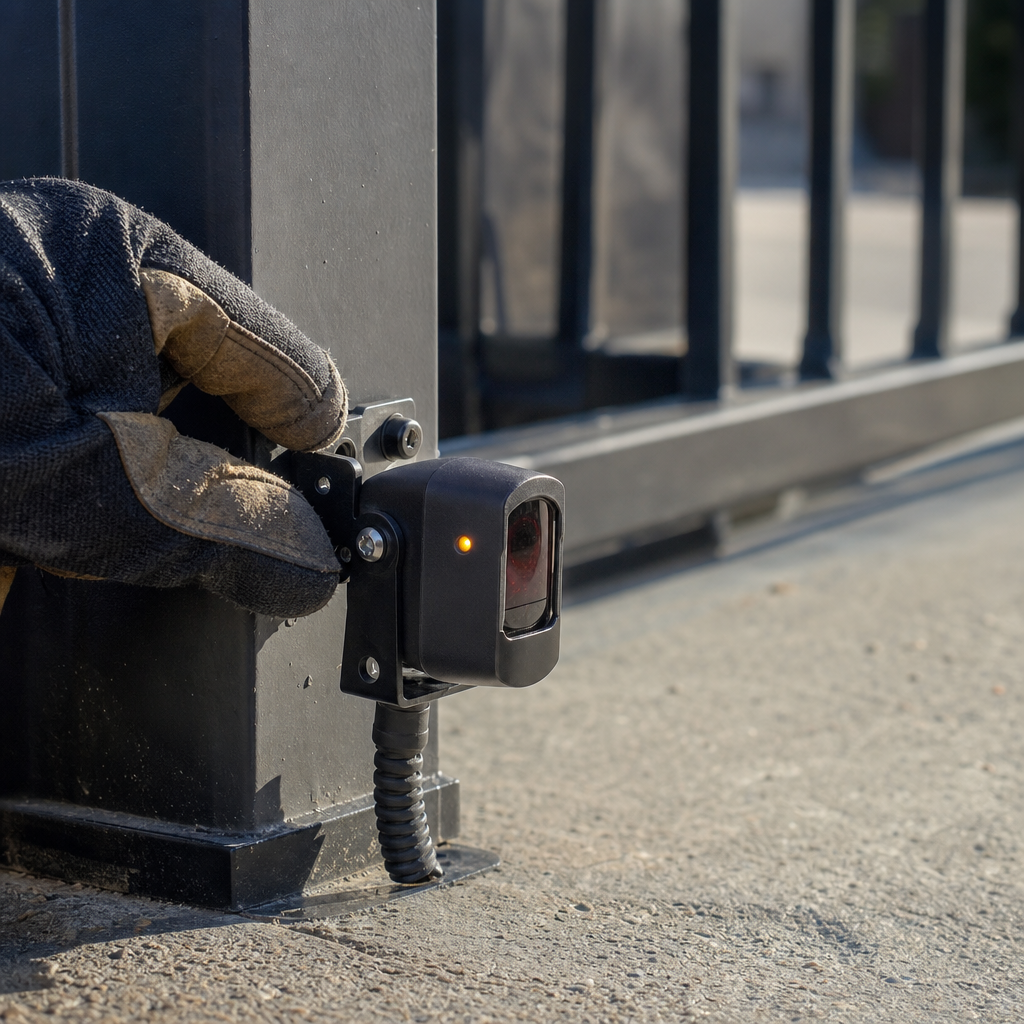
When an automated gate opens normally but refuses to close, or reverses direction midway through travel, the safety circuit has likely been interrupted. Safety standards require entrapment protection, and if a sensor circuit fails open, the logic board locks out closing commands to prevent property damage or injury.
Realignment and Lens Cleaning for Sunlight Glare
According to Ironworks Gate Co., infrared photo-eyes mounted on gate posts must stay properly aligned. Temperature swings can expand mounting brackets and push optical heads out of alignment, while low-angle sunlight can temporarily blind optical receivers. Wipe the lenses clean of debris, tighten mounting hardware, and verify that the diagnostic LED indicator stays solid when the beam path is clear.
Testing Inductive Exit Loops and Shadow Loops
Underground loop wires embedded in driveway pavement detect vehicle mass via inductance changes. When pavement cracking stresses buried wires, safety modules can generate continuous false triggers:
- Adjust the frequency channel dial on the loop detector card to stop crosstalk from adjacent loops.
- Lower the sensitivity setting if vibrating security gates or moving metal items trigger false vehicle detections.
- Test the loop with an ohmmeter across the lead-in wires; a functional inductive loop should typically read between 0.5 and 2.0 ohms of resistance with high insulation resistance to ground.
Step 5: Inspect Wiring Conduits for Weather and Ground Damage
Need gate access control repair anaheim?
We’re available now - call for a fast, free estimate.
Buried electrical conduits run through changing soil conditions, particularly on sloping driveways. Checking the integrity of underground runs helps prevent misdiagnosing broken conductors as complex electronic board failures.
Locating Broken Underground Low-Voltage Lines
When an access panel loses both power and communication, specialized line-tracing tools can locate the fault beneath the surface:
- Attach a low-voltage wire fault locator to the disconnected circuit to pinpoint breaks without extensive digging.
- Check conduit junction elbows at the driveway apron where soil compaction and vehicle traffic place mechanical stress on fittings.
Moisture Sealing and Thermal Expansion Safeguards
Temperature fluctuations can cause conduits to separate at poorly glued couplings. Sealing pedestal bases with expanding foam prevents warm, moist underground air from condensing inside cold metal keypad boxes, helping protect delicate circuit boards from short circuits and corrosion.
Step 6: Service Top Brands Like LiftMaster, DoorKing, and Nice Apollo
Servicing commercial and residential access equipment requires understanding manufacturer logic sequences and diagnostic fault codes. Proprietary boards communicate internal errors through specific LED blinks or numeric displays that indicate circuit status.[5]
Brand-Specific Diagnostic Codes and Circuit Boards
Systems from LiftMaster, DoorKing (DKS), Viking Access, and Nice Apollo feature dedicated diagnostic readouts on their primary boards. Reading these codes indicates whether an input is held open by a switch, a tripped edge sensor, or an internal board issue.
OEM Parts vs Generic Aftermarket Components
Ironworks Gate Co. notes that using original equipment manufacturer (OEM) replacement relays, circuit boards, and wireless receivers helps match the operational load specifications of the gate operator. Generic components may draw incorrect current, resulting in reduced service life or intermittent lockouts.
What Does Gate Access Control Repair Cost?
Driveway gate access control repairs typically focus on isolated electronic components or wiring adjustments rather than full system replacements. Total costs vary widely depending on the specific fault, required replacement parts, labor time, and site conditions such as conduit accessibility and property layout.[4]
Repair vs Replace Decision Framework
Repairing existing access hardware is generally suitable when the main housing is physically sound, replacement parts are readily available, and the underlying wiring is in good condition. If an entry panel is an obsolete analog model with severely degraded underground lines, retrofitting the gate with a modern cellular smart access controller is often more practical than trenching new cable runs.
Frequently Asked Questions About Gate Access Control
Why is my gate keypad or intercom not responding?
Keypads and intercoms fail most often from power loss (such as a tripped breaker or blown transformer), corroded terminal screws, or windblown dust settling behind the contact pad. Inspect the circuit breaker, confirm the power supply is delivering the correct voltage, and check that internal relays click when an authorized code is entered.
Can existing access control systems be upgraded with smartphone entry?
Yes. Most existing gate operators can be retrofitted with a standalone cellular or Wi-Fi smart receiver. This lets users open the gate, view visitor video feeds, and manage access directly from a phone without necessarily running new cables between the residence and the driveway apron.
Should I repair or replace my gate entry system?
As Ironworks Gate Co. explains, if the issue is isolated to a transformer, misaligned photo-eyes, or worn keypad buttons, repairing the individual component is typically straightforward. If the system is an obsolete model with severely degraded underground wiring, replacing it with a wireless cellular entry panel can provide updated functionality and avoid trenching work.
How is gate access control troubleshooting typically scheduled?
Response times and diagnostic scheduling depend on technician availability, parts inventory, and the nature of the electrical or mechanical fault.
Need gate access control repair anaheim?
We’re available now - call for a fast, free estimate.
Sources
- Business Databases A-Z – UC Berkeley Library Guides – guides.lib.berkeley.edu (2011)
- Regional Insights – grandviewresearch.com (2030)
- United States Access Control Market Size & Share Analysis – mordorintelligence.com (2031)
- State of the Market Access Control: Where Challenge … – sdmmag.com (2026)
- North America Access Control Market Report 2025-2030 [210 Pages & 240 Tables] – marketsandmarkets.com (2030)
Related reading: Automatic Gate Opener Troubleshooting – Call Now-10% Off – Same-Day Service – Free Estimate
Frequently Asked Questions
How quickly can emergency gate access control repair be completed in Anaheim?
Ironworks Gate Co. provides same-day diagnostic and repair dispatch throughout Anaheim, carrying dedicated multimeters, OEM relays, and replacement parts on service trucks. Most low-voltage wiring faults, keypad failures, and sensor misalignments can be fully resolved in a single visit without ordering delayed replacements.
Can underground gate wiring faults be fixed without digging up a concrete driveway?
Yes, technicians use low-voltage wire fault locators to pinpoint the exact location of subterranean breaks without excavating the entire driveway apron. If older conduits are severely collapsed or flooded, Ironworks Gate Co. can also retrofit modern cellular smart access modules to bypass damaged underground cabling entirely.
Why does my gate automatically reverse or fail to close during hot weather?
Anaheim summer heat causes thermal expansion in mounting brackets, which knocks infrared photo-eyes out of optical alignment and triggers the automatic safety reversal circuit. Ironworks Gate Co. re-secures sensor brackets, shields optical lenses from sunlight glare, and adjusts loop detector frequencies to eliminate false obstruction signals.
About the author
 |
David Harrison David Harrison is a seasoned technical writer with over eight years of experience specializing in the access control and home security industries. Holding a Bachelor’s degree in Communications from California State University, Fullerton, he translates complex gate repair diagnostics and pricing structures into clear, actionable advice for property owners. David’s practical insights help Orange County residents and businesses navigate automatic gate maintenance with confidence and transparency. |
Gate not opening, off track, or opener dead?
We’re available now - call for a fast, free estimate.
Call Now - Free Estimate