
Quick Summary
This comprehensive guide delivers diagnostic and troubleshooting protocols for Anaheim property owners dealing with stuck, unresponsive, or damaged automated gates. While basic issues like misaligned photo-eyes, dead remote batteries, and track debris can be resolved with DIY checks, Ironworks Gate Co. recommends professional service for motor replacements, high-voltage wiring, and structural welding. Readers will learn how to isolate mechanical binding from electrical faults, safely operate manual releases, and determine when to call for expert on-site troubleshooting and repair.
Gate Repair How to & Troubleshooting Guides in Anaheim
When an automated driveway or security gate stops working, diagnosing the problem starts with isolating mechanical resistance from electrical failure. Gate issues commonly stem from power disruptions, safety device activations, mechanical binding, or component wear. Before calling for service or attempting basic checks, property owners must prioritize safety. Safety Warning: Never bypass entrapment protection devices. Immediately stop using any gate system that exhibits structural damage, derailing, uncontrolled movement, or suspected electrical hazards. Always keep people and vehicles clear of the moving gate, and disconnect power before inspecting mechanical drive components.[2]
The guidance below outlines diagnostic considerations for sliding, swing, and overhead automatic gates. For complex electrical diagnostics, high-voltage wiring, structural welding, or component replacements, consult the specific operator manual and work with a qualified gate technician such as Ironworks Gate Co.
Quick Troubleshooting Guide: Why Your Gate Is Stuck or Unresponsive
Quick troubleshooting summary: If an automated gate will not open or close, common supported causes include loss of power, emergency-stop activation, physical obstructions, blocked or misaligned sensors, triggered sensing edges, and access control faults. Check the dedicated power source first, verify that safety devices are clear, and inspect the travel path for physical interference before contacting a qualified professional.
Use this diagnostic sequence to locate the source of an unexpected gate stoppage:
- Step 1: Check Power and Breaker Panels. Verify whether there is a loss of power. Check the main electrical panel for tripped circuit breakers, inspect any external disconnect switches near the motor enclosure, and verify that emergency-stop controls or reset switches have not been activated.
- Step 2: Inspect Safety Sensors and Edges. Check optical photo-eyes and contact edges for blockages, misalignment, or damage. A blocked, dirty, or misaligned sensor or a triggered reversing edge will prevent the gate from completing its cycle. Refer to the manufacturer manual for model-specific status indicator lights.
- Step 3: Check for Obstructions and Mechanical Binding. Turn off electrical power and disengage the manual release according to the operator manual. Check whether the gate moves freely along its path or if it is hindered by physical obstructions, debris in the track, damaged rollers, or hinge binding.
- Step 4: Check Access Control Inputs. Verify whether the issue is caused by a control fault. Test individual input devices such as keypads, remotes, intercom relays, or loop detectors to determine if a specific control device is failing to send an open or close signal.
Automatic Gate Repair
Automatic gate systems rely on continuous communication between logic boards, safety sensors, and mechanical drive linkages. When a monitored safety circuit opens or a control fault occurs, the operator halts movement to prevent injury or property damage.
Common Automatic Gate Failures
Automated gates can experience mechanical wear, electrical disruptions, and alignment problems over time. Hinge fatigue, track debris, drive hardware wear, foundation movement, and component strain can cause gates to bind or fail to reach their limit positions.
Diagnosing Controller Boards vs. Mechanical Overload
Modern operators often provide diagnostic status indicators or display boards that signal why a cycle was interrupted. An over-current or force-limit indication frequently means the drive mechanism is fighting physical resistance (such as a dragging leaf or obstructed track) rather than a failed control board. Always consult the operator manual to interpret model-specific diagnostic indicators before replacing parts.
Safety Standards and Compliance
ASTM F2200 standard covers automated vehicular gate construction across horizontal slide, horizontal swing, vertical lift, vertical pivot, overhead pivot, and horizontal bifold gates. The standard includes provisions concerning fall-over protection, hazardous protrusions, and positive stops. Depending on whether a project involves repairing an existing installation, upgrading automation, or completing a new installation, applicable provisions of safety standards such as UL 325 and local building codes apply. Device requirements vary based on the specific gate class, installation type, and applicable code context.
Gate Opener Repair
Gate opener service addresses the motor unit, drive mechanisms, limit settings, and internal control hardware that govern gate movement.
Testing Limit Switches and Travel Settings
Limit switches define where the motor stops the gate at full open and full close. Over time, vibration, wear, or settling can cause limits to shift. If a gate stops short or over-travels, refer to the manufacturer manual to adjust the limit settings. Never force mechanical or digital limit assemblies beyond their specified ranges.
Troubleshooting Remotes, Transmitters, and Keypads
If an opener responds to hardwired controls but ignores wireless transmitters:
- Check and replace transmitter batteries, and inspect the antenna for visible damage or shielding.
- Follow the model-specific programming and pairing procedures outlined in the operator manual.
- For vehicle-integrated transmitters, consult the specific vehicle and operator instructions for proper pairing sequences.
Motor Capacitors and Drive Mechanisms
If an opener hums when activated but fails to move the gate, the issue may involve a failing start/run capacitor, an obstruction, or mechanical resistance in the drive train. High-voltage capacitors and internal drive components should only be tested and serviced by qualified personnel following manufacturer safety guidelines.
Electric Gate Repair
Electric gate troubleshooting addresses control wiring, vehicle detection loops, backup batteries, and incoming power lines.
Underground Loop Detector and Sensor Troubleshooting
Inductive loops detect vehicle mass to open the gate or prevent closure. When loop detectors fail:
- Check the loop detector module inside the control box for fault or continuous detection indicators per the manufacturer manual.
- Inspect the driveway surface where loop wires are embedded for pavement cracking or sealant deterioration.
- Consult the module documentation to check sensitivity settings and prevent phantom activations.
Solar Panel and Battery Backup Testing
Solar-powered and battery-backup operators rely on proper charging and functional rechargeable batteries. Use a multimeter to test battery voltage according to the manufacturer specifications for resting and operating loads. Batteries that fail to hold required operating voltage must be replaced according to the equipment manual.[4]
Enclosure Maintenance and Electrical Protection
Outdoor control enclosures are vulnerable to moisture, dirt, and insect entry through unsealed conduit openings. Contaminants on circuit boards can cause short circuits and control faults. Keep enclosure seals intact, ensure conduit penetrations are sealed, and inspect control boxes during regular maintenance.
Gate Installation
Need gate repair how to & troubleshooting guides in anaheim?
We’re available now - call for a fast, free estimate.
Proper gate installation balances structural support, driveway grade, foundation requirements, and environmental forces.
Matching Gate Design to Site Conditions
Solid-panel privacy gates experience higher wind resistance than open ornamental designs with pickets. Gate framework, posts, and hinges must be engineered to withstand anticipated wind loads and physical stress based on the specific site and gate dimensions.
Engineering for Slopes and Driveway Grades
Sloped driveways require specialized planning and hardware. Depending on grade and property layout, solutions may include specialized uphill-biasing hinges, outward-swing layouts where permitted, or cantilever slide configurations engineered to operate on grade without binding.
Safety and Building Compliance
Automated gate installations must comply with local municipal building and electrical codes. City building-permit records may help identify previously permitted work on a property, though permit databases do not confirm all historical work or the current physical condition of a system. New installations and automation upgrades must comply with applicable UL 325 and ASTM F2200 requirements as enforced by local jurisdictions.[3]
Driveway Gate Repair
Driveway gates experience frequent cycles and environmental exposure, making them subject to wear, foundation movement, and potential vehicle impact.
Mechanical Binding vs. Operator Faults
When a gate stops unexpectedly during its cycle, determine whether the cause is mechanical binding or a control fault. Disengage the operator manual release as directed by the manual and move the gate by hand. Resistance or binding along the travel path indicates a mechanical issue such as track, hinge, or roller problems rather than a control board failure.
Fixing Dragging Gates
A gate leaf dragging across driveway pavement causes structural damage and motor strain. To evaluate gate drag:
- Inspect hinge assemblies and adjustable hardware for wear or looseness, adjusting according to manufacturer instructions.
- Check the support post with a level to determine if the post or foundation has shifted. Footing movement requires structural repair.
- Inspect the gate frame for weld fatigue, sagging, or structural deformation.
Vehicular Impact and Emergency Structural Assessment
If a vehicle strikes a gate system, a comprehensive structural inspection is required. Historical safety data indicates that gate accidents, derailing, and falling gate panels present severe hazards; these historical records illustrate safety risks but do not represent current local repair volume or failure rates. Stop using any gate with structural damage, bent guide rollers, damaged catch posts, or cracked welds until evaluated by a qualified professional.[5]
Iron and Metal Gate Repair
Metal and tubular steel gates provide structural strength, but corrosion and weld stress can compromise integrity over time.
Remediating Rust and Corrosion
Corrosion can form along bottom rails, joints, and hinge connections on metal gates. To treat corroded areas:
- Remove loose rust, scale, and degraded paint down to clean metal using appropriate mechanical tools.
- Apply a suitable rust-inhibiting primer designed for exterior metal surfaces.
- Finish with protective exterior coatings formulated for metal gate applications.
Welding Cracked Hinges and Structural Posts
Heavy metal gates apply substantial loads to hinge attachment points. When welds crack or brackets deform, discontinue automated operation immediately to prevent gate collapse. Structural welding and re-alignment of posts and hinges should be performed by qualified welders, such as the specialists at Ironworks Gate Co.
Restoring Ornamental Walk and Driveway Gates
Restoring heavy ornamental assemblies requires inspecting the primary structural framework. Bent pickets, sagging panels, or loose mounting hardware should be repaired to ensure balanced weight distribution and smooth movement.
Sliding Gate and Track Repair
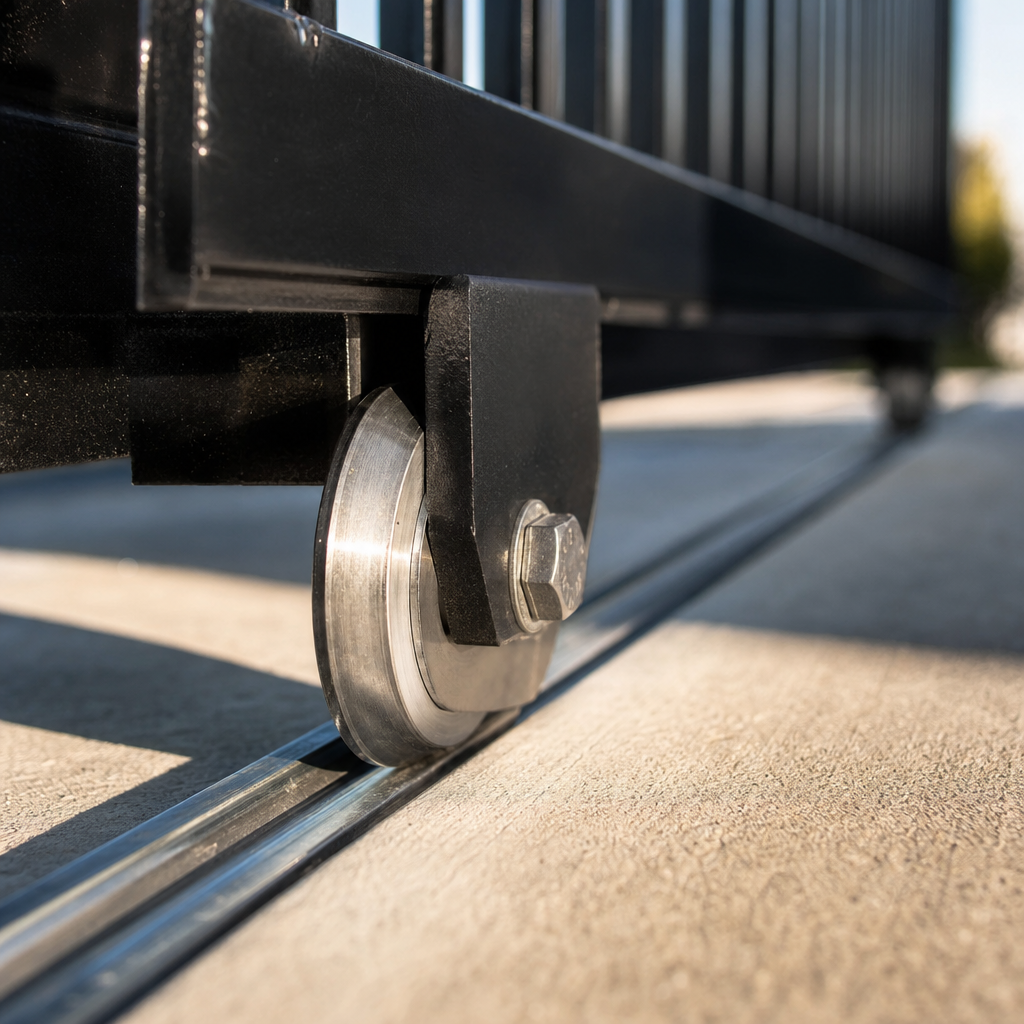
Sliding gates operate on ground V-tracks or cantilever guide systems, requiring clear travel paths and functional bearings.
Clearing Ground Track Obstructions
Ground-mounted tracks collect gravel, dirt, and debris that can obstruct or derail guide wheels. Clean track channels regularly. Check track mounting anchors to ensure the track remains securely fastened to the concrete foundation without loose sections or deflection.
Roller Bearing Maintenance and Replacement
If a sliding gate produces unusual grinding noises or resists movement, roller bearings may be worn or seized. Many commercial-grade gate rollers utilize sealed bearing assemblies that cannot be serviced with external lubricants once failed; worn roller assemblies must be replaced.
Drive Chain and Guide Hardware Inspection
Slide gate drive chains and guide rollers must be tensioned and aligned according to the operator manufacturer specifications. Chains that are excessively tight or loose cause premature wear on drive sprockets and output shafts, while misaligned guide rollers can cause binding or derailment.
Swing Gate Repair
Swing gates require plumb support posts, properly aligned hinges, and secure operator mounting brackets.
Correcting Gate Post Sag and Alignment
Dual-swing gates must align accurately at the center to latch properly. If leaves fail to meet correctly:
- Inspect post footings for soil shifting, cracking, or movement.
- Adjust hinge assemblies where adjustable hardware is present, following manufacturer guidelines.
- Consult a structural or gate professional if posts require reinforcement or replacement.
Servicing Linear Actuators and Arm Operators
Electromechanical and hydraulic swing operators require clean drive components and proper fluid levels where applicable. If an actuator arm stutters, stalls, or leaks fluid, consult the specific operator manual for service procedures, seal inspections, and approved replacement parts.
Positive Stop Adjustments and Safety Provisions
Under ASTM F2200 standards, swing gate provisions include positive stops to limit gate travel. Properly positioned stops prevent over-extension of operator arms and help protect mounting brackets and posts during wind or force loads.
Wood and Steel Frame Gate Repair
Need gate repair how to & troubleshooting guides in anaheim?
We’re available now - call for a fast, free estimate.
Gates combining wood infill with steel frames provide privacy while relying on the metal sub-frame for structural rigidity.
Moisture Expansion and Weight Imbalances
Wood components absorb moisture during wet weather, adding weight to the gate assembly. This increased weight can cause mechanical drag or trigger operator obstruction responses. Maintain appropriate ground clearance beneath bottom pickets to reduce direct water absorption from pavement.
Reinforcing Structural Sub-Frames
Over time, wide wood gates can sag if framing hardware loosens. Installations utilizing structural steel sub-frames help resist sagging. If deflection occurs, adjustable diagonal bracing or frame reinforcement can restore proper squareness.
Preventing Gate Drag
- Inspect frame fasteners and tighten loose hardware caused by seasonal expansion and contraction.
- Check corner welds on sub-frames for signs of fatigue or cracking.
- Ensure adequate clearance along the entire swing or slide arc to prevent ground contact.
Gate Parts and Components for Automated Systems
An automated gate relies on an integrated system of mechanical, structural, and electrical assemblies.
Gate Operators, Motors, and Control Boards
The control board processes commands from access devices, safety sensors, and limit switches. Qualified technicians utilize diagnostic tools and operator documentation to isolate power faults, relay failures, or component damage.
Hinges, Rollers, Tracks, and Guides
Heavy-duty hinges and rollers carry the dynamic weight of the gate leaf, while top guide assemblies keep sliding gates upright. Regular inspection and manufacturer-recommended lubrication of serviceable pivot points help maintain smooth movement.
Drive Chains, Belts, and Linkages
Drive chains, belts, and mechanical arms transfer motor output to the gate leaf. Inspect these components periodically for wear, rust, tension, and correct alignment.
Access Controls
Keypads, telephone entry systems, cellular controls, and vehicle loop detectors interface with the operator logic board. Testing involves checking power delivery, control signal continuity, and relay activation per equipment instructions.
Safety Sensors and Entrapment Protection Devices
Monitored safety devices, such as photo-eyes and contact edges, are designed to stop or reverse gate movement upon detecting an obstruction. Monitored entrapment protection device requirements depend on the installation type, date, and applicable UL 325 and local code standards.
Major Gate Operator Brands and Diagnostic Resources
Gate operator manufacturers incorporate distinct control boards, diagnostic displays, and interface menus across their product lines.
Manufacturer Diagnostic Interfaces
Brands such as LiftMaster, DoorKing, Viking Access, Nice Apollo, HySecurity, and others provide specific diagnostic indicators, LEDs, or digital readouts on their control boards. These indicators signal power status, limit positions, safety sensor activation, or system faults. Because diagnostic codes and LED interpretations differ across models and firmware versions, property owners and technicians should always refer to the specific operator manual for troubleshooting procedures.
Understanding Gate Repair Costs
Gate repair costs depend on the source of the failure, component availability, labor requirements, and whether structural fabrication or electrical work is necessary.
Standard Gate Service Categories
| Service Category | Diagnostic & Repair Scope | Safety & Compliance Focus |
|---|---|---|
| Diagnostic Inspection | Isolating power delivery, control faults, and safety loop status | Verifies operational safety devices and entrapment protection |
| Track, Roller & Hinge Repair | Realigning dragging leaves, replacing worn rollers, repairing broken hinges | Ensures fall-over protection, positive stops, and level travel |
| Motor & Control Board Service | Servicing drive motors, logic boards, and limit switch assemblies | Restores manufacturer-specified auto-reverse and force settings |
| Complete Operator Replacement | Installing a properly rated operator matched to gate weight, grade, and duty cycle | Meets applicable ASTM F2200 and UL 325 installation requirements |
Factors Influencing Overall Repair Costs
Repair pricing is shaped by several practical factors:
- Operator duty rating: Light-duty residential operators generally differ in replacement and component costs compared to continuous-duty commercial or industrial systems.
- Structural metalwork: Simple component replacements require less labor than mobile welding repairs for damaged hinge posts or structural gate frames.
- Wiring and excavation: Repairing underground conduits, control wiring, or vehicle loops adds labor and equipment requirements.
Gate Service Considerations
Automated gate systems require ongoing preventive maintenance to ensure safe and reliable operation regardless of property type or location.
General Operating Considerations
Driveway grade, gate panel weight, wind exposure, and cycle frequency all influence wear rates on automated gate systems. Properties with elevated wind exposure or sloped approaches require properly matched hardware, robust posts, and appropriately rated operators to avoid premature mechanical failure.
Routine Maintenance
Periodic maintenance helps prevent sudden failures. Key tasks include keeping sensor lenses clean, inspecting physical tracks and swing paths for debris, checking for structural wear, and testing battery backup systems according to manufacturer guidance.
Frequently Asked Gate Repair and Troubleshooting Questions
Why is my automatic driveway gate not opening or closing?
Common causes include loss of power, a tripped breaker, blocked or misaligned safety photo-eyes, triggered contact edges, depleted remote batteries, access control faults, or physical obstructions along the gate path. Check power sources and safety sensors, and consult the operator manual for diagnostic light indicators.
How do I manually open an electric gate during a power outage?
Automated gate operators include a model-specific manual release mechanism, such as a keyed release door, release lever, or disconnect pin. Consult your operator manual for exact manual release instructions, and always turn off power before manually operating the gate.
What are common electric gate motor problems?
Common issues include failed start/run capacitors, misadjusted or worn limit switches, control board damage from power surges or moisture, and mechanical binding that triggers force-reversal limits.
How do I troubleshoot gate opener remotes and sensors?
For safety sensors, ensure optical lenses are clean, free of obstructions, and properly aligned according to their status indicators. For remotes, replace batteries and refer to the operator manual for the correct code pairing or programming sequence.[1]
When should I perform basic checks versus hiring a qualified pro?
Property owners can safely perform basic visual checks, clean sensor lenses, clear track debris, replace remote batteries, and reset standard power disconnects. However, work involving high-voltage wiring, logic board replacement, loop detector installation, structural welding, or derailing and falling gate panels should be handled by a qualified technician, such as those at Ironworks Gate Co.
Why is my sliding gate making a grinding or screeching noise?
Grinding noises typically indicate worn, damaged, or seized bearings inside the track rollers, or physical scraping between the gate leaf, track, and guide components. Worn roller assemblies should be inspected and replaced by a professional.
Need gate repair how to & troubleshooting guides in anaheim?
We’re available now - call for a fast, free estimate.
Sources
- ANAHEIM – fullerton.edu (2025)
- U.S. Census Bureau QuickFacts: Anaheim city, California – census.gov (2023)
- Local Profiles – Anaheim – scag.ca.gov
- Anaheim, CA Population & Demographics (2024) | US Census Data – uscivicdata.com (2024)
- City of Anaheim Open Data – main-anaheim.opendata.arcgis.com
Related reading: Driveway Gate Repair – Call Now-10% Off – On-Site in 60 Minutes – Free Estimate
Related reading: Swing Gate Repair Anaheim – Call Now-10% Off – On-Site in 60 Minutes – Free Estimate
Related reading: Gate Hinge Repair Anaheim – Call Now-10% Off – On-Site in 60 Minutes – Free Estimate
Frequently Asked Questions
How often should automated gates undergo professional inspection and safety testing?
Residential and commercial systems should receive a professional inspection at least once or twice every year. Regular preventative checkups by technicians like Ironworks Gate Co. ensure entrapment protection devices, limit switches, and mechanical hinges remain compliant with UL 325 standards before costly breakdowns occur.
What should I do if the manual release key or disconnect lever is jammed during a power failure?
Never force a stuck release lever or pin, as excessive force can crack internal drive linkages or gearbox housings. Keep the electrical breaker turned off to prevent sudden movement, and contact Ironworks Gate Co. for same-day on-site troubleshooting to safely disengage the mechanical drive.
Can a damaged sliding gate V-track be repaired, or does it require full replacement?
Minor track bends or loose concrete anchors can frequently be straightened and re-anchored on site. If the track suffers from severe rust perforation or shifted concrete footings, Ironworks Gate Co. provides custom metal fabrication and track replacement to protect roller bearings from rapid wear.
About the author
 |
David Harrison David Harrison is a seasoned technical writer with over eight years of experience specializing in the access control and home security industries. Holding a Bachelor’s degree in Communications from California State University, Fullerton, he translates complex gate repair diagnostics and pricing structures into clear, actionable advice for property owners. David’s practical insights help Orange County residents and businesses navigate automatic gate maintenance with confidence and transparency. |
Gate not opening, off track, or opener dead?
We’re available now - call for a fast, free estimate.
Call Now - Free Estimate