
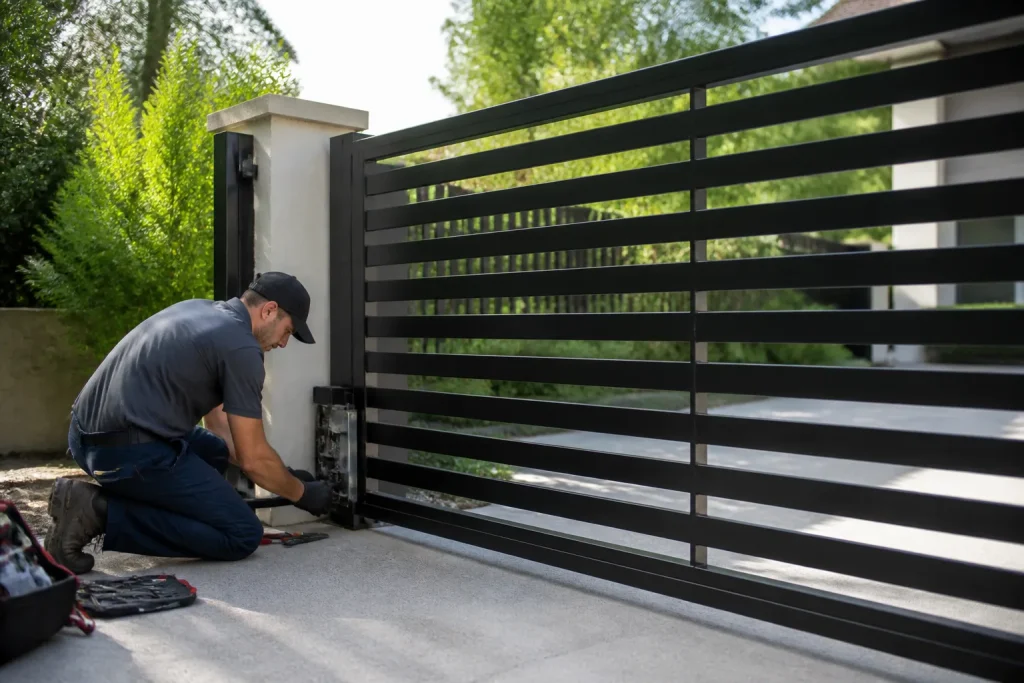
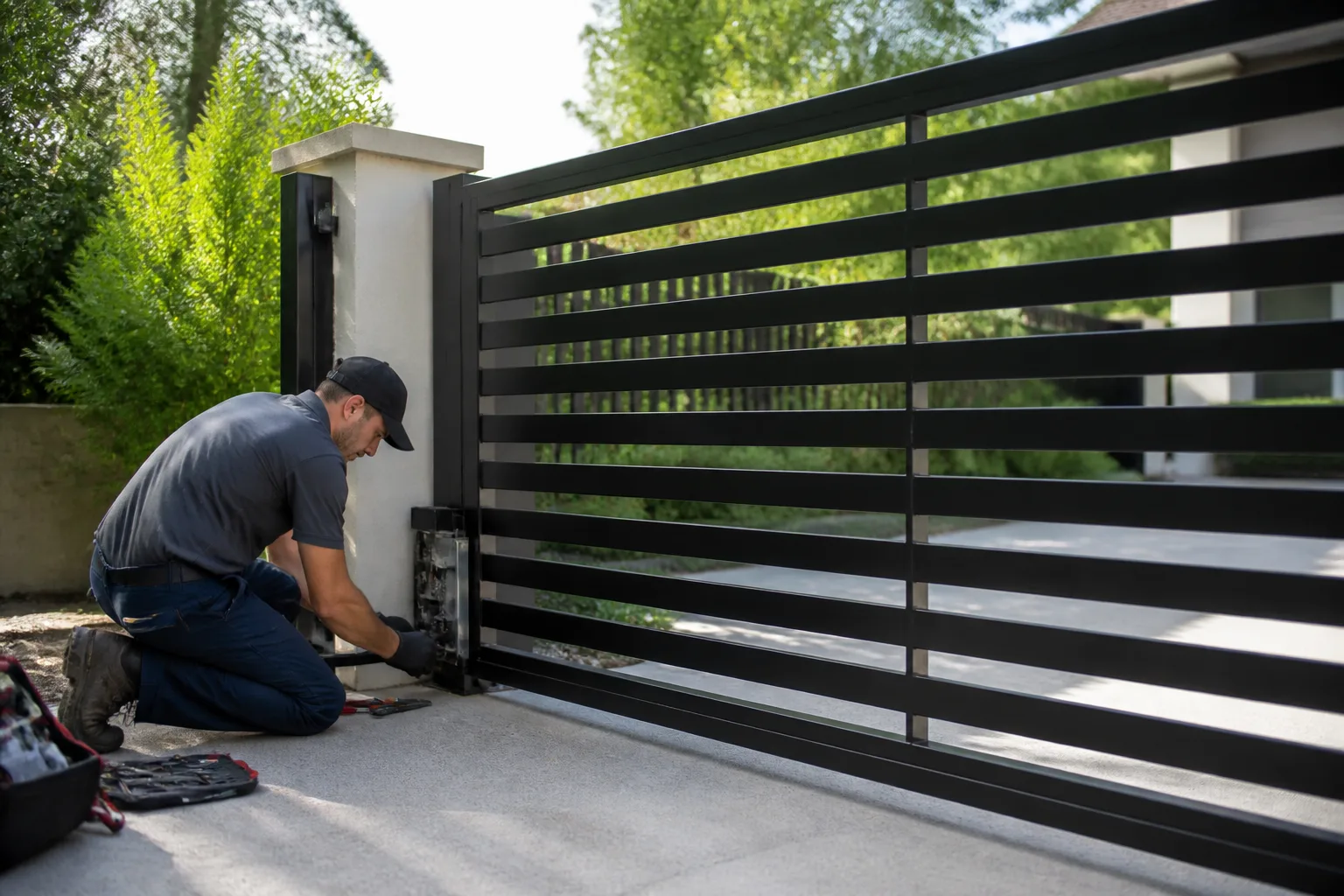
Elite Gate Repair in Anaheim: A Homeowner’s Guide
Elite gate repair in Anaheim isn’t about paying premium prices for a fancy truck. It’s about hiring someone who understands both halves of the system: the steel that holds your gate up and the motor that moves it. Most failed repairs we’re called to fix trace back to a technician who handled one half well and ignored the other. If you’d rather not sort through the details yourself, call us at (424) 395-3381 and we’ll give you a straight answer.
A gate that fails halfway open at 11 p.m. isn’t a convenience problem. It’s a security breach. And here’s the part that surprises most Anaheim homeowners: nearly every callback we run starts with a first repair that addressed only one side of a two-part system. The hinge got welded but the motor strain was never checked. The circuit board got replaced but nobody noticed the sagging leaf that burned it out. A gate is the one mechanical system on your property handling structural load, electrical current, and daily security at the same time. The bar for good enough is higher than it looks.
Key Takeaways
- A driveway gate is a two-part system: structural metalwork and automation. Fixing only one side guarantees a callback.
- Anaheim’s UV exposure and coastal air create failure points that generalist repairmen routinely miss.
- A real diagnosis looks different from a parts swap. A written estimate tells you which one you’re getting.
- A written workmanship guarantee covers what verbal promises can’t. Get it in writing, every time.
- There’s a difference between a gate that opens and a gate restored to manufacturer-rated cycle life.
What “Elite” Actually Means for Gate Repair
Nobody wakes up wanting an elite gate repair. They want a gate that closes. But the word means something specific in this trade, and it has nothing to do with pricing. An elite repair is one that addresses the root cause, not the symptom. It’s done by a technician who can weld a cracked hinge bracket and then diagnose why the motor was straining against that bracket for six months before it failed.
Here’s an example from a home near the Anaheim Hills border. The gate wouldn’t fully close. A previous repair had replaced the limit switch, which fixed it for about three weeks. When we opened the motor housing, the gears showed abnormal wear on one side. The real issue was a sagging leaf that had shifted the gate’s travel arc by barely half an inch. That half-inch was loading the motor unevenly on every single cycle. The limit switch was a victim, not the cause. We welded a reinforcement plate at the hinge side, realigned the leaf, and replaced the switch. That was two years ago. The gate still closes like the day it was hung.
That’s the difference. A parts-swapper replaces what’s broken. A gate specialist finds out why it broke. In Anaheim, where many homes have gates that are fifteen, twenty, or thirty years old, that distinction matters more than in newer developments.
Why Gates Require Dual Expertise: Metal and Motor
A driveway gate is one of the few things on your property that is simultaneously a structural object and an electrical device. A fence post holds a panel. A garage door rolls on tracks. But a gate swings or slides on hinges or rollers while a motor pushes against its full weight, cycle after cycle, year after year. It’s part blacksmith work and part electrician work. Most generalist handymen are neither.
Here’s what happens when the structural side is ignored:
- The gate leaf sags a few degrees. The motor works harder to compensate.
- The hinges wear unevenly. The motor runs longer on each cycle to reach the close limit.
- Friction builds at the pivot points. The circuit board reads the resistance and draws more current.
- One day the board burns out, or the gearbox strips, and the gate stops. The homeowner calls someone who replaces the board. The sagging leaf is still there. The new board burns out in eight months.
Now here’s what happens when the automation side is ignored:
- The motor gets replaced but the new one is wired to old, corroded terminals.
- The opener’s force settings are never re-calibrated for the new motor, so the safety reversal either trips constantly or never trips at all.
- The technician doesn’t check the photo eye alignment because the gate “works now.” Three weeks later, the gate reverses on its own for no visible reason.
We service nine major automation brands, including LiftMaster, FAAC, BFT, and Linear. The brand matters because each has its own force calibration procedure, its own error code language, and its own common failure modes. A LiftMaster board and a BFT board don’t fail the same way. A technician who knows one brand well and “figures out” the others is guessing. In Anaheim, with gates exposed to full sun and coastal air, guessing gets expensive.
How Anaheim’s Climate Attacks Your Gate
Anaheim sits close enough to the coast to get marine air and far enough inland to get serious heat. That combination does predictable things to gate hardware, and most of it happens slowly, invisibly, until something breaks.
UV degradation on powder coat. Powder coating is the standard finish on steel gates, but Anaheim’s sun breaks it down faster than manufacturers’ average estimates suggest. Once the powder coat chalks and micro-cracks, the steel underneath starts rusting. We see it most often on westward-facing gates in neighborhoods like West Anaheim and the Colony, where afternoon sun hits the gate full-force for hours. A gate that’s ten years old with original powder coat often has rust starting at the weld joints, where the coating is thinnest. That rust isn’t cosmetic. It eats into the structural welds that hold the gate together.
Coastal particulate in motor housings. The marine air that comes through the Santa Ana canyon carries fine salt particulate. It settles into motor housings, onto circuit boards, and into limit switch contacts. Over time, that particulate corrodes connections and increases electrical resistance. A motor that draws 8 amps when new might draw 11 amps five years later, not because anything is broken, but because the electrical path is degrading. The motor runs hotter. The board works harder. The life span drops. We open motor housings in Anaheim and find grey film on the circuit boards that you don’t see in, say, Riverside or Corona. It’s the coastal air doing its quiet work.
Thermal cycling on welds. Anaheim’s summer days and cool desert nights create daily expansion and contraction cycles. Over years, that thermal cycling stresses weld joints, especially on long gate leaves. Cracks start small, hairline, invisible under the powder coat. By the time they’re visible, they’ve been growing for a season or two. A generalist sees a cracked weld and grinds it out and re-welds it. A specialist asks why that particular joint cracked and whether the gate’s weight distribution is shifting. Weld repair without a diagnosis is just buying time.
How to Read a Repair Estimate
When you get an estimate for gate repair in Anaheim, the single most revealing thing isn’t the price. It’s whether the estimate describes a diagnosis or a parts list. A diagnosis names the cause. A parts list names the symptom.
Here’s a diagnostic estimate: “Replace worn hinge bushings on left leaf, realign gate to restore even load distribution, recalibrate opener force settings to manufacturer spec for the reduced drag. Includes weld touch-up on hinge plate where stress cracking is visible.”
Here’s a parts-swap estimate: “Replace limit switch. Test operation.”
Both estimates might be priced similarly. One of them fixes the gate. The other buys you a few weeks.
When you read an estimate, ask three questions:
- Does it name a cause? If the estimate says what broke but not why it broke, the repair is incomplete. Hinge bushings wear out for a reason. Motors burn out for a reason. If the reason isn’t on the estimate, it hasn’t been found.
- Does it mention the other half of the system? A structural repair that doesn’t mention checking the motor afterward is a red flag. An opener replacement that doesn’t mention the physical condition of the gate is another one. The two halves always affect each other.
- Is the scope in writing? If the scope of work is vague, the final bill can be vague too. A written estimate should say exactly what will be done, with what parts, and for what price. At Ironworks Gate Co., the price is quoted and agreed before any work starts. There’s no discovery on your invoice.
One more thing about estimates: the lowest one is often the least diagnostic one. A technician who quotes a lower price because he’s planned less work isn’t doing you a favor. He’s doing less. Gates don’t respond to optimism.
What a Written Guarantee Actually Protects You From
Every contractor says they stand behind their work. Almost none of them put it in writing. That distinction matters because a verbal promise protects you from exactly nothing. If something fails three weeks after a repair, a verbal promise means you’re calling and hoping. A written guarantee means you’re calling and knowing.
Our company has done this work for over 42 years, and we’ve built our reputation on a simple rule: if it’s not right, we come back and make it right. That’s the 90-Day Done Right Promise. It’s written, it’s simple, and there’s no paperwork to file and no one to argue with. If a repair we made fails within 90 days because of a defect in our workmanship or materials, we fix it. That’s the entire policy. We call it the Keystone Standard because everything we do rests on it.
Here’s what a written workmanship guarantee should cover:
- Parts installed during the repair. If the part fails through no fault of yours within the term, it’s replaced. Parts have manufacturer warranties too, but the workmanship guarantee means you’re not the one chasing the manufacturer.
- Labor on the repair. If the same issue recurs because the first repair was incomplete, the second visit isn’t a new invoice.
- Adjustments and fine-tuning. A gate that technically works but doesn’t close smoothly, that reverses occasionally, that makes a new noise it didn’t make before. Those count as “not right.” We fix them.
What a verbal promise protects you from is the awkwardness of the first phone call. After that, you’re on your own. Get it in writing.
“Working” vs. Restored to Cycle Life
There’s a philosophical split in gate repair, and most homeowners never see it until it costs them. Some technicians define success as “the gate moves when you press the button.” Others define it as “the gate moves the way the manufacturer rated it to move, for the cycle life the manufacturer rated it for.” Those are not the same thing.
Every gate opener has a rated cycle life. Most residential openers are rated for somewhere between 10,000 and 25,000 cycles, depending on the brand and model. A cycle is one full open-and-close. If you use your gate six times a day, a 15,000-cycle opener should last somewhere around seven years. But that rating assumes proper installation, regular maintenance, and a gate that moves freely without excess resistance.
When a gate sags, or the hinges bind, or the rollers are shot, every cycle counts as more than one cycle against the motor. The motor draws more current. The gears wear faster. The board runs hotter. A gate that should run seven years might burn through an opener in three. And each replacement opener suffers the same conditions, so each one dies early too. That’s the hidden cost of a “working” gate.
A repair that restores the gate to cycle life is one that addresses the mechanical resistance first, the electrical load second, and the hardware third. That’s the order of operations a specialist follows. Fix the physical gate so it moves freely. Verify the electrical draw is within manufacturer spec. Then replace the parts that actually failed. It takes longer on the front end and saves years on the back end.
Related services in Anaheim: If you’re dealing with a gate that’s beyond repair or you’re planning a new installation from scratch, our Gate Installation in Anaheim service covers everything from custom fabrication to final programming. And if your issue is specifically the motor, not the structure, see our Gate Motor & Opener in Anaheim page for diagnostics and replacement details.
When to Call a Professional
We believe in honest self-assessment. Some gate maintenance is genuinely DIY-appropriate: lubricating hinges with the right product, tightening visible fasteners, clearing debris from the track on a sliding gate. Those are maintenance tasks, not repairs.
But there are clear lines where a professional is the only sensible call:
- The gate doesn’t move under its own power. This is electrical, and electrical gate systems carry live current. A trained technician isolates the problem before touching anything. A homeowner with a multimeter and confidence can do real damage to a circuit board that costs hundreds to replace.
- The gate is off its track or visibly sagging. This is structural. A steel gate leaf, even a decorative one, weighs hundreds of pounds. If it comes off its track or off a hinge while you’re working on it, that’s a serious injury risk. We’ve pulled bent gates out of garages in Anaheim after DIY attempts went sideways.
- The motor runs but the gate doesn’t move. This means something has failed between the motor and the gate: a gearbox, a coupling, a drive chain. Opening the motor housing to look is where the damage happens. These assemblies are under mechanical tension and wiring arrangements vary by brand.
- Any repair involving the spring system on a counterweighted gate. Counterweighted gates and some slide gates use springs to balance the load. A spring under tension stores enough energy to cause serious injury if it releases suddenly. This is never a DIY job.
The honest rule: if the repair requires opening a motor housing, cutting or welding metal, or adjusting anything under spring tension, that’s a professional’s job. The cost of a service call is less than the cost of fixing what a failed DIY attempt breaks.
Why Local Anaheim Experience Matters
Gates fail differently in different places. A gate in Phoenix fails from extreme heat. A gate in Seattle fails from constant moisture. A gate in Anaheim fails from the specific combination of UV, marine air, and thermal cycling we described earlier. A technician who has worked in Anaheim for years has seen those failures hundreds of times. He knows what a coastal-air circuit board looks like before he opens the housing. He knows which neighborhoods have older gates with obsolete hardware that needs retrofitting rather than replacement. He knows which brands hold up well in this climate and which ones don’t.
Ironworks Gate Co. opened its doors in 1984, and we’ve been serving Anaheim and the surrounding communities since then. Our founder, Victor Salinas, built this company on the idea that a gate repair should be the last time a homeowner has to think about that gate. We train our technicians on nine automation brands, we run background checks on every person we hire, and we show up in uniform, ready to do the work the way we’d do it in our own mothers’ driveways. The 400th job gets the same care as the first. That’s not a slogan. It’s the job.
You can read more about our general repair services on our Gate Repair in Anaheim page. And if you’re new to our company, the Ironworks Gate Co. home page gives you the full picture of who we are and how we work.
The Bottom Line
Elite gate repair in Anaheim comes down to depth: depth of diagnosis, depth of trade knowledge, and depth of local experience. A gate is a two-part system, and any repair that treats it as one part will fail again. Anaheim’s climate accelerates that failure. The fix is to hire someone who understands the metal and the motor, who writes a diagnostic estimate, who puts the guarantee in writing, and who aims for cycle life, not just movement.
If you’re in Anaheim and your gate needs attention, call Ironworks Gate Co. at (424) 395-3381 for a free estimate. We’ll tell you what’s wrong, what it costs, and what we’ll do to make it right. No pressure, no surprises. Just the gate, done right, and backed in writing.
Frequently Asked Questions
Gate repair in Anaheim typically runs between $150 and $600 for most common issues, with structural welding or full opener replacement pushing into the $800 to $2,500 range depending on scope. The price is always quoted and agreed before any work starts, so the number you hear is the number you pay. Call (424) 395-3381 for an exact quote on your gate, free of charge.
In many cases, yes. We keep common parts in our service vehicles for LiftMaster, FAAC, BFT, and Linear systems, which means many repairs are completed in a single visit. A live person answers our phone 24 hours a day, 7 days a week, so you’ll know immediately whether we can be there today. Call (424) 395-3381 and tell us what the gate is doing.
A full gate installation includes site measurement, fabrication or sourcing of the gate itself, post setting, hinge and hardware installation, opener mounting and wiring, safety edge and photo eye configuration, and final programming. The scope and timeline depend on whether you’re replacing an existing gate or building new, and whether the power run is already in place. Call (424) 395-3381 to schedule a free measure and written estimate.
Yes. We handle the full automation scope: running power to the opener location, installing photo eyes and safety edges to meet current standards, and programming the opener for proper force settings and travel limits. This work is done by our own technicians, not subcontracted out. Call (424) 395-3381 with your address and we’ll walk you through the options.
Written by Victor Salinas, Owner at Ironworks Gate Co., serving Anaheim since 2013.
Need Gate Repair Help?
Call Ironworks Gate Co. - licensed & insured, here with fast after-hours help in Anaheim.
(424) 395-3381